Peer Support Worker Jobs in Homelessness Services
What is a peer support worker or "expert by experience" in UK homelessness services? Real live vacancies, pay, requirements and how lived experience counts.
Key Takeaways
- A "peer support worker" or "expert by experience" is someone with their own lived experience of homelessness who is employed, formally trained and paid to support others going through it now.
- Independent research reviewed in a peer-reviewed homelessness study links peer support to real, measured improvements in quality of life, substance use, social support and mental health for the people receiving it.
- In London, Groundswell's Homeless Health Peer Advocacy service runs entirely on peer advocates with lived experience of homelessness, working across eight boroughs to help people access healthcare.
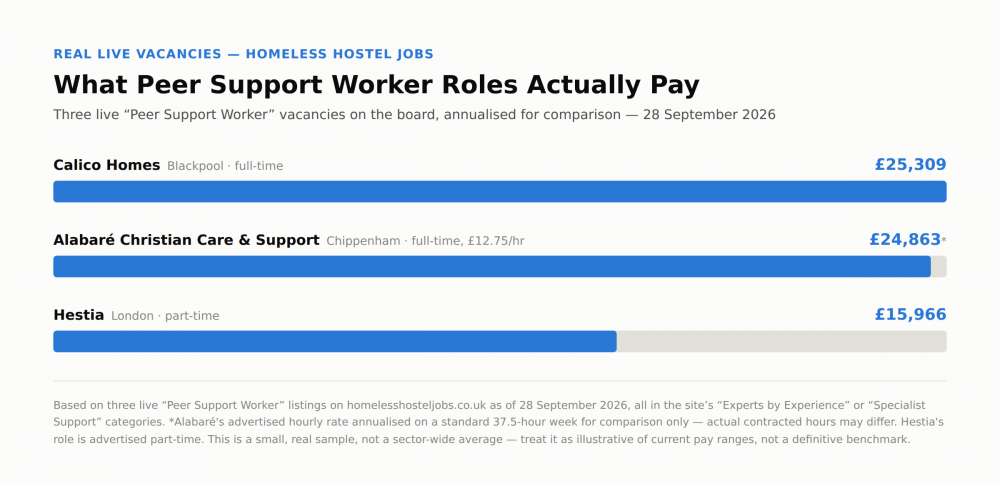
- Three live Peer Support Worker vacancies on this board as of 28 September 2026 pay between roughly £15,966 (part-time) and £25,309 (full-time) — real figures, not averages.
- Most roles ask for genuine lived experience of homelessness, housing insecurity, substance use or related crisis rather than a formal qualification, though an Enhanced DBS check is standard.
If you've been through homelessness yourself, one of the most direct ways to use that experience is as a peer support worker — sometimes advertised as an "expert by experience," "peer advocate" or "peer mentor." These are paid, structured roles built around a simple idea: someone who has actually slept rough, sofa-surfed, or lived in supported housing can reach people in crisis in a way that a worker without that background often can't. This guide explains what the role actually involves, what the evidence says about why it works, and what real vacancies on this board are paying right now.
What is a peer support worker in homelessness services?
A peer support worker is a paid staff member whose own lived experience of homelessness, housing crisis, substance use or related hardship is a core part of the job, not just a personal detail. Rather than a case file and a set of forms, the peer support worker brings shared understanding: they have queued at a day centre, waited on a housing list, or navigated the same benefits system the people they support are dealing with now.
The role sits alongside — not instead of — qualified support workers, housing officers and specialist caseworkers. A 2016 review of the evidence, "Experts by Experience: Peer Support and its Use with the Homeless," describes peers as having "a unique capacity to help each other based on a shared affiliation and a deep understanding" that comes from having lived through it themselves.
What the evidence says peer support actually does
This isn't just a feel-good add-on. The same review found that peer support in homelessness and related services is associated with measurable improvements across several areas: better overall quality of life and fewer life problems; reduced drug and alcohol use and lower relapse rates; a stronger sense of belonging and less loneliness; improved mental health symptoms and functioning; and higher engagement and retention in the services people are referred to.
The review identifies four reasons peer support tends to work: shared experience builds trust faster than a professional relationship alone can; peers can role-model that recovery and stability are genuinely possible; they provide practical and emotional support day to day; and their presence itself improves attendance and engagement with services. The researchers do flag one caveat worth being honest about: peer support in UK homelessness services has often been rolled out "without a supporting evidence base" for the specific local model used, even where the wider evidence for peer support is positive.
How the role works in practice: Groundswell's peer advocates
One of the clearest working examples in the UK is Groundswell's Homeless Health Peer Advocacy (HHPA) service, which operates across eight London boroughs — Camden, Hackney, Hammersmith and Fulham, Kensington and Chelsea, Lambeth, Southwark, Tower Hamlets and Westminster. Every peer advocate on the programme has experienced homelessness themselves. Their job is to help people attend and understand medical appointments, navigate the healthcare system, get practical support around hospital stays, and build the confidence to use health services independently. Some peer advocates progress into paid Care Navigator or Caseworker roles within the same organisation, having started as volunteer advocates — a real, documented progression route from peer volunteering into a paid homelessness-sector career.
What these roles actually pay: three live examples
Rather than estimate, here are three genuine Peer Support Worker vacancies live on this board as of 28 September 2026:
- Calico Homes, Blackpool — full-time Peer Support Worker, £25,309 a year, listed under the board's "Experts by Experience" category.
- Alabaré Christian Care & Support, Chippenham — full-time Peer Support Worker for a mental health service, £12.75 an hour (around £24,863 a year on a standard 37.5-hour week).
- Hestia, London — part-time Peer Support Worker, £15,966 a year pro rata, in the "Experts by Experience" category.
Three listings is a small, real sample, not a sector-wide benchmark — but it does show that peer roles are being advertised at broadly comparable rates to entry-level support worker roles elsewhere on the board, not treated as unpaid or token positions.
What you typically need to apply
The single most important qualification for most peer support roles is genuine, relevant lived experience — of homelessness, housing insecurity, the care system, substance use, the criminal justice system, or a closely related crisis — that you're willing to draw on to support others. Beyond that, employers commonly ask for:
- An Enhanced DBS check, since the role involves regular contact with people who may be vulnerable — standard across almost all frontline homelessness roles on this board.
- Recovery or stability in your own situation, since the role asks you to hold space for someone else's crisis while managing your own wellbeing.
- Willingness to complete structured training, such as safeguarding, boundaries, and peer-support-specific induction — most employers train peers into the role rather than expecting it on day one.
- Basic recording and communication skills, since peer roles still involve case notes, referrals and reporting back to a wider team.
Formal qualifications in social work, counselling or care are rarely a strict requirement for entry-level peer roles, though they can help with progression into supervisory or specialist positions later.
Where to find peer support and "experts by experience" roles
On this board, these roles are usually listed under the Experts by Experience category, and sometimes under Specialist Support when the peer element sits inside a wider mental health or recovery service, as with the Alabaré role above. Because it's a smaller, more specialist category than general support work, it's worth checking both regularly and setting up a job alert rather than relying on a single search.
If you're weighing this up against other entry points into the sector, our guides to getting a homeless hostel job with no experience and to what supported housing work involves cover the wider range of frontline roles peer support sits alongside.
Frequently Asked Questions
Is a peer support worker the same as a volunteer?
No. Peer support workers are paid employees. Some organisations, including Groundswell, do also run volunteer peer advocate programmes, and volunteering that way can be a genuine route into a paid role, but "peer support worker" as a job title on this board refers to paid positions.
Do I need to disclose my own experience of homelessness to apply?
Employers advertising these roles are specifically looking for lived experience, so discussing it appropriately in your application is expected and usually essential — it's the core qualification for the role, not a disclosure you need to avoid.
Will I need an Enhanced DBS check?
Almost always, yes, because the role involves regular contact with people who may be vulnerable. A past conviction does not automatically rule you out; most employers assess relevance to the specific role rather than applying a blanket exclusion.
Can a peer support role lead to other jobs in the sector?
Yes. Groundswell's own peer advocacy programme has produced Care Navigators and Caseworkers who started as peer volunteers, and the skills built in peer roles — casework basics, safeguarding awareness, and direct client support — transfer well into wider support worker and specialist support positions.
Is peer support only relevant to homelessness charities?
No. NHS mental health services also employ peer support workers, and the underlying model — someone with lived experience supporting others further behind in their own journey — is used across mental health, substance use and social care more broadly, not only within homelessness-specific organisations.
Sources: "Experts by Experience: Peer Support and its Use with the Homeless," PMC/National Institutes of Health; Groundswell, Homeless Health Peer Advocacy. Salary figures are drawn directly from live vacancy listings on homelesshosteljobs.co.uk as of 28 September 2026 and will change as those listings are filled or expire.