Housing Support Worker Jobs UK: Pay, Duties & Routes In
What does a UK housing support worker do, and what do they earn? Real 2026 salary data from 36 live vacancies, routes in, and how it differs from a Housing Officer.
Search for "housing support worker jobs" and you'll mostly find a single vacancy, a generic job board listing, or a recruiter's pay calculator — not much that explains what the role actually involves day to day, what it pays across the sector right now, or how it's different from a "Housing Officer" or a generic "Support Worker." Those three titles get used almost interchangeably in job adverts, which makes searching harder than it should be. Here's a real answer, built from live vacancies currently advertised on Homeless Hostel Jobs.
Key Takeaways
- A Housing Support Worker helps residents in supported or temporary accommodation live independently — practical life-skills support, welfare and benefits help, keeping support plans current — rather than managing the tenancy itself.
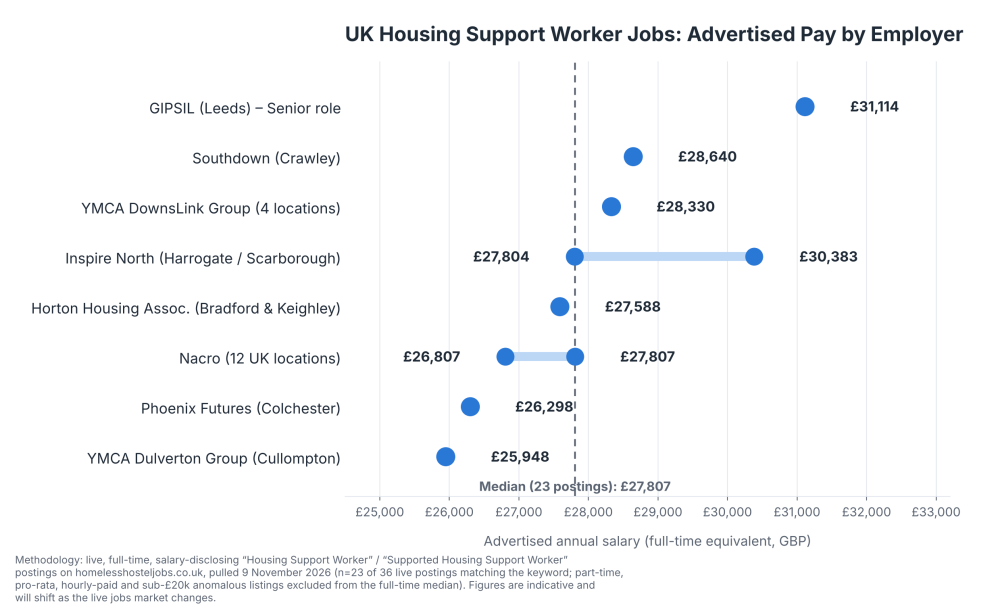
- Of 36 live "Housing Support Worker" postings on this board (9 November 2026), 23 are full-time and disclose a salary. The median is £27,807, ranging from £25,948 to £31,114 for a senior post.
- The National Careers Service's closest official profile, Residential Support Worker, puts typical UK pay at £22,000 (starter) to £30,000 (experienced) — consistent with what's being advertised on this board right now.
- It's a different role from a Housing Officer, who manages the tenancy (allocations, rent, repairs) rather than day-to-day wellbeing — see our Housing Officer guide for that comparison.
- No degree is required — college courses, apprenticeships, volunteering and direct application (often with full training) are all recognised routes in, though an enhanced DBS check is standard.
What Does a Housing Support Worker Actually Do?
A Housing Support Worker's focus is the person, not the property. Where a Housing Officer deals with the landlord side of a tenancy — allocating it, collecting rent, arranging repairs — a Housing Support Worker works directly with residents in supported housing, hostels or temporary accommodation to help them build the skills and stability to live independently. Across the live postings reviewed for this piece, recurring duties include:
- Running one-to-one support sessions and building a personalised support plan with each resident
- Teaching practical life skills — budgeting, cooking, shopping, claiming benefits
- Helping residents access welfare advice, healthcare, education or employment support
- Liaising with social workers, probation, mental health teams and other agencies on a resident's behalf
- Keeping case notes, risk assessments and support plans up to date and GDPR-compliant
- Responding to incidents and, in some settings, taking part in a waking-night or sleep-in rota
This matches the National Careers Service's closest official job profile, Residential Support Worker, which lists very similar day-to-day tasks: supporting residents' personal development and confidence, running one-to-one or group sessions, teaching practical life skills, and liaising with families and other professionals.
How Much Do Housing Support Worker Jobs Pay in 2026?
Rather than rely on a generic salary survey, we pulled every live "Housing Support Worker" and "Supported Housing Support Worker" vacancy on Homeless Hostel Jobs as of 9 November 2026 — 36 postings in total.
Of those 36, 23 are full-time roles that disclose a salary — the rest are sessional/bank-work posts paid hourly, explicitly part-time or pro-rata roles, or a handful of postings with implausibly low annual figures that look like data errors rather than real offers, all of which we've set aside rather than blending into a full-time figure. Across the 23 remaining postings, the median advertised salary is £27,807, with most roles clustering tightly between £26,300 and £28,650. A handful of outliers bookend that range: YMCA Dulverton Group's Cullompton post at £25,948, and a Senior Housing Support Worker role with GIPSIL in Leeds at £31,114 — a useful marker of where pay can go with more experience and responsibility.
That figure sits close to the £28,800 median we found for "Support Worker" roles generally in our UK Homelessness & Housing Sector Salary Guide, and squarely within the National Careers Service's £22,000–£30,000 range for the closest official profile, Residential Support Worker. Employers advertising the most Housing Support Worker roles on this board right now — Nacro (12 live postings nationally, consistently at £26,807–£27,807) and YMCA DownsLink Group (4 postings across Sussex at £28,330) — both pay close to that median, which suggests it's a genuinely representative figure rather than one pulled up or down by a single large employer.
Housing Support Worker vs Housing Officer vs Support Worker: What's the Difference?
These titles overlap constantly in real job adverts, which is exactly why this is hard to search for. Broadly:
- Housing Support Worker — the role above: works directly with residents in supported or temporary housing on life skills, welfare and day-to-day wellbeing. Doesn't manage the tenancy itself.
- Housing Officer — manages the landlord side of a tenancy: allocating properties, collecting rent, arranging repairs, handling tenancy breaches. Our Housing Officer guide found a £36,000 median for this role — notably higher than Housing Support Worker pay, reflecting its more senior, tenancy-management remit.
- Support Worker (generic, not housing-specific) — the same resident-facing support function as a Housing Support Worker, but potentially in a non-housing setting (a day centre, outreach team, or residential care). Our Salary Guide found a £28,800 median across all Support Worker postings sector-wide — close to, but not identical to, the housing-specific figure above.
In practice, many employers use "Housing Support Worker," "Supported Housing Worker" and plain "Support Worker" to describe near-identical roles — always read the actual job description rather than relying on the title alone.
Qualifications and How to Get Into Housing Support Worker Work
No degree is required to become a Housing Support Worker. Per the National Careers Service's Residential Support Worker profile, the realistic routes in are:
- College course — health and social care, or a related diploma; entry requirements vary by course and provider.
- Apprenticeship — foundation-level apprenticeships need no specific qualifications or experience and are open to a wide age range; intermediate and advanced apprenticeships typically ask for GCSEs including English and maths.
- Work — starting as an assistant support worker and training on the job, then moving into a full Housing Support Worker post through experience and, often, employer-funded training.
- Volunteering — experience in a hostel, charity, youth club or caring for a family member is commonly cited by employers as useful preparation.
- Direct application — many employers in this sector (several of the Nacro and YMCA postings reviewed for this piece among them) hire primarily on the right personal qualities and provide full training, rather than requiring a specific qualification upfront.
An enhanced DBS check is standard across almost every posting reviewed, since the role involves direct, unsupervised contact with vulnerable adults. A handful of postings also mention a full UK driving licence (useful for outreach or multi-site roles) and willingness to work a waking-night or sleep-in rota as part of a 24/7 service.
Do You Need Experience?
Unlike some frontline sector roles, a genuine share of the Housing Support Worker postings we reviewed are open to people without direct prior experience, provided the employer offers structured induction and training — several Nacro and YMCA postings explicitly say so. That makes it one of the more realistic entry points into the UK homelessness and supported housing sector for a career-changer, alongside the roles covered in our "No Experience?" guide. Prior experience in care, customer service, youth work or a related field will still strengthen an application and may unlock a slightly higher starting salary.
Where the Jobs Are Right Now
At the time of writing, Homeless Hostel Jobs carries 560 live, published vacancies board-wide, of which 94 sit in the Housing and Accommodation sector and 36 are specifically titled "Housing Support Worker" or "Supported Housing Support Worker." Current postings come from national charities with a large, steady footprint — Nacro (12 live postings spanning Southampton to Scunthorpe), YMCA DownsLink Group (Sussex), Inspire North (North Yorkshire) — through to smaller regional providers such as Horton Housing Association, Phoenix Futures, Southdown and GIPSIL. New roles are added daily, so treat the specific figures here as a snapshot rather than a fixed inventory.
Frequently Asked Questions
What does a Housing Support Worker do?
A Housing Support Worker helps residents in supported or temporary housing build independent living skills — budgeting, benefits, healthcare access, keeping a support plan on track — rather than managing the property or tenancy itself.
What's the average salary for a Housing Support Worker in the UK?
Based on live postings on this board, the median full-time salary is £27,807, with most roles falling between roughly £26,000 and £29,000, and senior posts reaching £31,000+. The National Careers Service's closest official profile (Residential Support Worker) gives a broadly similar £22,000–£30,000 range.
What's the difference between a Housing Support Worker and a Housing Officer?
A Housing Support Worker focuses on a resident's day-to-day wellbeing and support plan. A Housing Officer manages the tenancy — allocations, rent, repairs, tenancy breaches — and tends to pay more (median £36,000 on this board). See our Housing Officer guide for the full comparison.
Do I need experience or a qualification to become a Housing Support Worker?
Not necessarily. Many employers hire on the right personal qualities and provide full training, though an enhanced DBS check is standard. College courses, apprenticeships and volunteering are all recognised alternative routes in, per the National Careers Service.
Ready to find your next role? Browse Housing and Accommodation vacancies, read our full sector Salary Guide, or see all current vacancies on Homeless Hostel Jobs, updated daily from across the UK homelessness and housing sector.
Methodology: salary figures for Housing Support Worker roles are based on a live pull of all "Housing Support Worker" and "Supported Housing Support Worker" postings on homelesshosteljobs.co.uk on 9 November 2026 — 36 postings, of which 23 are full-time and disclose a salary (part-time, pro-rata, hourly-paid and a small number of anomalously low sub-£20,000 listings were excluded from the full-time median). Figures for the broader sector are drawn from our own Salary Guide (316 salaried postings, refreshed 7 September 2026). External role and qualification information is sourced from the National Careers Service's Residential Support Worker job profile, cited above. Figures are indicative and will shift as the live jobs market changes.