No Experience? How to Get a Homeless Hostel Job in 2026

Key Takeaways
You don't need a background in social care to start working in UK homelessness and supported housing services — but you do need to know which roles genuinely welcome beginners and what checks and training actually replace "experience" on a CV.
- A live check of this board's vacancies found 32 of 743 postings (4.3%) explicitly stated no prior experience was necessary or that full training would be provided.
- Most beginner-friendly roles cluster in Support Worker, Housing & Tenancy Support, and Outreach & Advice — not in management or clinical positions.
- An enhanced DBS check is the near-universal requirement, not a formal qualification.
- Life experience — caring for a relative, volunteering, retail or hospitality work — genuinely counts, and most new starters complete the Care Certificate or an equivalent induction on the job.
- Search demand for "no experience" hostel and shelter jobs is real and currently under-served with dedicated guidance, which is exactly the gap this article fills.
Do you actually need experience to work in a homeless hostel?
Not always — though it depends heavily on which role you're looking at. Search interest in phrases like "no experience homeless shelter jobs" and "drop in shelter support worker jobs" is consistently high, which tells us plenty of people are weighing up a move into this sector without a relevant background. Most don't find a clear answer, because very little published guidance addresses the question directly.
The honest answer is that entry requirements vary by employer and by role. Some frontline support worker and night concierge positions are advertised as open to beginners with full training given; others, particularly anything involving clinical, safeguarding-lead or management responsibility, expect relevant experience or a recognised qualification. The rest of this guide sets out, with real figures rather than guesswork, roughly how common genuinely beginner-friendly roles are on this board, which parts of the sector they sit in, and what employers ask for instead of experience.
What we found when we checked every live vacancy on this board
Methodology: on 10 September 2026 we pulled every job marked "Active" on Homeless Hostel Jobs (743 live postings) via the board's own API and searched each title and description for a fixed set of phrases — "no experience necessary", "no previous experience", "no experience required", "full training provided" and close variants. This is a conservative, phrase-based count: it will miss postings that welcome beginners in different words (for example, listing only "a caring attitude" or "transferable skills"), so the true beginner-friendly share of the board is likely higher than the headline figure below.
32 of the 743 live vacancies (4.3%) explicitly said no prior experience was required, or that full training would be given. Broken down by the kind of role, those 32 postings split as:
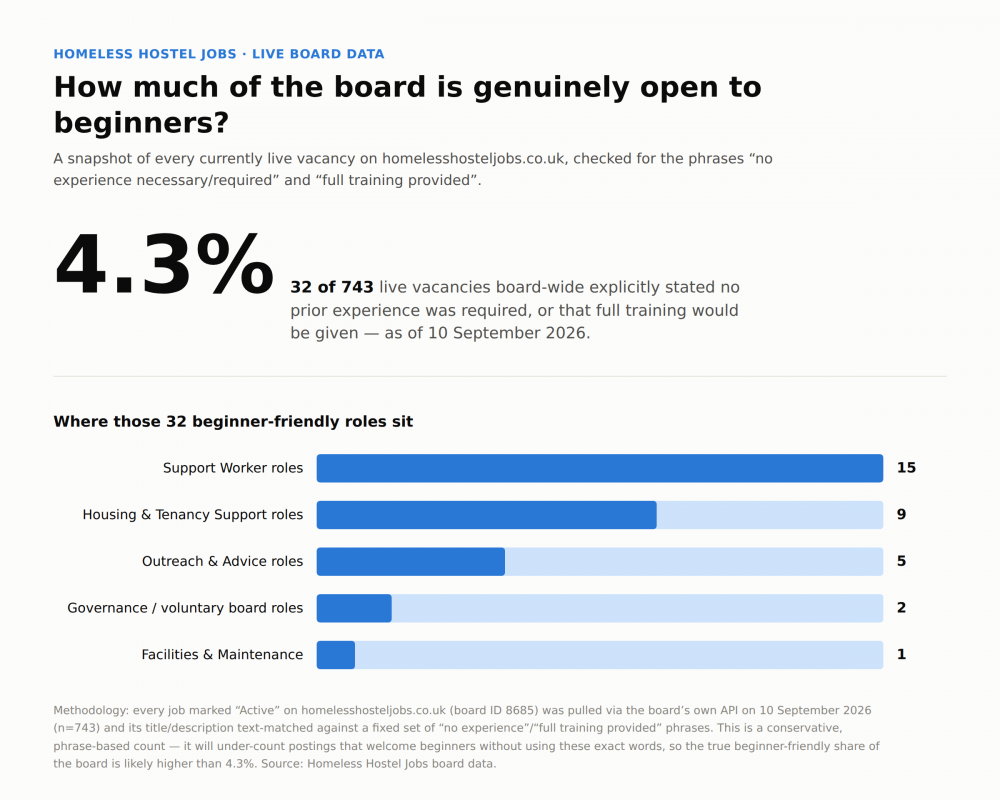
- Support Worker roles — 15
- Housing & Tenancy Support roles — 9
- Outreach & Advice roles (money advice, benefits, debt and energy advice, reconnection work) — 5
- Governance / voluntary board roles (trustee positions) — 2
- Facilities & Maintenance — 1
That pattern matches what most people already assume about the sector: frontline support work is the most common way in without prior experience, followed by housing and tenancy support and advice-based roles. Clinical, safeguarding-lead and senior management positions were not represented in the beginner-friendly group at all — those consistently asked for relevant experience or a professional qualification.
What UK employers in this sector actually ask for instead of experience
An enhanced DBS check, almost without exception
Whatever your background, expect to need an enhanced Disclosure and Barring Service (DBS) check before you can start any role working closely with people who may be vulnerable. This is separate from, and more thorough than, the basic or standard checks used for many other jobs, and it's a legal safeguarding requirement rather than a judgement on your suitability. Most employers in this sector will sponsor or arrange the check as part of the recruitment process rather than expecting you to pay for it yourself — it's worth confirming this at application or interview stage, since practice does vary.
Often, no formal qualification at all
The UK government's own National Careers Service is direct about this for the closest comparable role, care worker: some employers ask for GCSEs in English and maths, "but many will offer training to applicants who have the right personal qualities" — and it explicitly notes that "time spent caring for someone you know also counts as having experience in a caring role." That's a useful yardstick for support work in homelessness services too: a caring attitude, reliability, and the right values are frequently weighed more heavily than a certificate.
Right to work in the UK, and (for driving roles) a licence
As with any UK employer, you'll need to demonstrate your right to work. Some outreach or peripatetic support roles that involve travelling between sites also ask for a driving licence, though this is role-specific rather than sector-wide.
Training you can expect once you're hired
"Full training provided" isn't just a recruitment phrase. New starters in adult social care and supported housing roles are commonly enrolled on the Care Certificate — a nationally recognised induction standard covering areas like safeguarding, duty of care, communication, health and safety, and person-centred care. It's designed specifically for people with no prior care experience, and completing it is often treated as the practical equivalent of the "experience" a job advert might otherwise ask for. Expect this to run alongside shadowed shifts, e-learning modules on safeguarding and fire safety, and a probation period with regular supervision — standard practice across the sector, not something unique to any one employer.
Which entry-level roles are most realistic to target
Based on both the board data above and the kinds of postings that most consistently use beginner-friendly language, the roles worth prioritising in a search are:
- Support Worker (day or waking-night) — the single largest source of genuinely entry-level roles on this board.
- Night Concierge / waking-night roles — frequently paired with full training and a lone-working induction rather than a formal qualification requirement.
- Housing or Tenancy Support Worker — practical, relationship-based work helping people sustain a tenancy, often open to career-changers.
- Outreach and advice roles (money, debt, benefits advice) — where a background in customer service, retail or call-centre work is frequently accepted as transferable.
- Trustee positions — unpaid, but a genuine and low-barrier way to build sector knowledge and references if you're exploring the field before committing to paid work.
Search current openings in these categories directly via the Support & Frontline Services and Housing and Accommodation categories.
Life experience and transferable skills that genuinely count
Employers in this sector consistently look for evidence of a handful of qualities that don't require a CV line in "homelessness services": resilience under pressure, clear written communication (for handovers and case notes), calm de-escalation, and simply having supported another person through a difficult period — whether that was a family member, a friend, or a customer in a previous job. Hospitality, retail, security, care-at-home and youth work backgrounds all transfer well. If you're building your first application, our guides on writing a support worker cover letter and crafting a standout CV for this sector both go into how to present exactly this kind of experience.
How to apply with no direct experience
Once you've identified a realistic entry-level role, the practical steps are the same ones any new sector requires: tailor your CV to highlight transferable skills rather than trying to disguise the lack of direct experience, be upfront in your cover letter about why you want to move into this work, and prepare for values-based interview questions rather than technical ones. Our guide to homeless hostel interview questions covers the kind of scenario-based questions ("what would you do if...") that come up far more often than knowledge tests at this level, and what to expect in your first week is worth reading before you start so the induction period feels less daunting.
Frequently asked questions
Can I really get a support worker job with zero experience?
Yes, for a meaningful share of postings — our snapshot found dozens of live roles explicitly saying so, concentrated in support worker, housing support and advice roles. It's the exception rather than the rule across the whole board, so search and apply broadly rather than assuming every listing is closed to you without experience.
Do I need a qualification before I apply?
Usually not to start. Many employers provide the Care Certificate or an equivalent in-house induction once you're hired, rather than requiring it upfront.
What DBS check will I need?
Almost universally an enhanced DBS check, since the role involves working closely with people who may be vulnerable. Most employers arrange and cover the cost of this as part of onboarding.
Is volunteering a good way in?
Yes — volunteering or a trustee position is a recognised route into the sector and a way to build references and sector knowledge before applying for paid roles.
Ready to look for a genuinely entry-level role? Browse current vacancies on Homeless Hostel Jobs, or start with our Support & Frontline Services category, where most of the board's beginner-friendly roles are listed.
Sources: Homeless Hostel Jobs board data (live API pull, 10 September 2026); UK National Careers Service job profiles for Care Worker and Housing Officer (nationalcareers.service.gov.uk); UK Disclosure and Barring Service guidance on DBS check levels (gov.uk).