Live-In & Sleep-In Jobs in UK Homelessness Services (2026)
What "accommodation included" really means for live-in, sleep-in and waking night roles in UK homelessness services, the Mencap ruling, 2026-27 NMW offset rates, and live vacancy data.
Scroll through vacancies in the UK homelessness and supported housing sector for long enough and you'll keep running into the same phrase: "accommodation included," "sleep-in shifts," "live-in role," "waking night worker." For anyone new to the sector — or weighing up whether a role with on-site accommodation is actually a good deal — the terms get used loosely, and the pay rules behind them are genuinely confusing even to people who've worked in care and support roles for years. This guide sets out what each term actually means, how pay law treats overnight hours, and how common these roles are right now on HomelessHostelJobs.co.uk.
"Accommodation included" isn't one thing — it's at least four
In homelessness and supported housing recruitment, "accommodation-linked" roles usually fall into one of four patterns, and mixing them up is the single biggest source of confusion for jobseekers:
Live-in / tied accommodation roles. The worker's main residence is on-site (often a self-contained flat or bedsit within or attached to the project) and is a condition of, or benefit tied to, the job itself. These are most common in small supported housing projects and services for young people leaving care, where having a trusted adult based on-site around the clock is part of the service model.
Sleep-in shifts. The worker is contracted to a normal daytime role but also sleeps on-site overnight on a rota, in a staff bedroom, expected to be woken only if something goes wrong. This is the most common accommodation-adjacent pattern in hostels and medium-to-high support projects, and it's the one with the most case law behind it (see below).
Waking night roles. The worker is awake and on duty for the entire overnight shift — this is simply night work, paid in full like any other shift, and is not a sleep-in despite often being advertised in the same breath. Several current HHJ listings use "waking night" specifically to distinguish themselves from sleep-in roles for this reason.
Housing and accommodation sector roles. A separate, larger category of jobs — housing officers, supported housing workers, accommodation managers — where "accommodation" is the subject of the work (managing or allocating housing) rather than a live-in benefit of the job itself. These are worth distinguishing because they show up in the same searches but mean something different.
The law: sleep-in shifts and the National Minimum Wage
For years it was genuinely unsettled whether sleep-in workers were entitled to the National Minimum Wage (NMW) for every hour of a sleep-in shift, or only for the hours they were actually awake and working. The question reached the Supreme Court in Royal Mencap Society v Tomlinson-Blake [2021] UKSC 8, and the ruling has governed sector pay practice ever since: sleeping hours during a sleep-in shift are not "working time" for NMW purposes unless the worker is actually awake and carrying out duties. A worker is only entitled to the NMW for the hours they are awake and working, not for the full duration of the shift.
In practice that means a typical sleep-in allowance (a flat overnight payment, separate from hourly pay) is lawful even if, divided across the full sleep-in period, it works out below the hourly NMW — provided any time the worker is actually called on to work during the night is paid at least the NMW for those hours on top. It also means the distinction between a "sleep-in" and a "waking night" role in a job advert isn't just wording: it changes what you're legally owed.
The accommodation offset: what employers can (and can't) deduct
Where an employer provides accommodation as part of the job, there's a separate, specific rule most jobseekers have never heard of: the NMW accommodation offset. For the 2026–27 NMW year, an employer can count up to £11.10 per day (£77.70 per week) of accommodation value toward NMW pay without it counting as a deduction from wages. Charge the worker more than that for the accommodation, and the excess is treated as reducing their pay for NMW compliance purposes — which can tip an apparently NMW-compliant salary into an underpayment once the real cost of the accommodation is factored in.
For context, the National Living Wage for workers aged 21 and over is £12.71 an hour from April 2026 (£10.85 for ages 18–20, £8.00 for under-18s and apprentices). Any role advertised with free or discounted accommodation should be assessed against these figures: free accommodation worth more than the offset cap is a genuine benefit on top of NMW-compliant pay; a high accommodation charge set near or above the cap is worth asking about directly before accepting an offer.
How common are these roles right now?
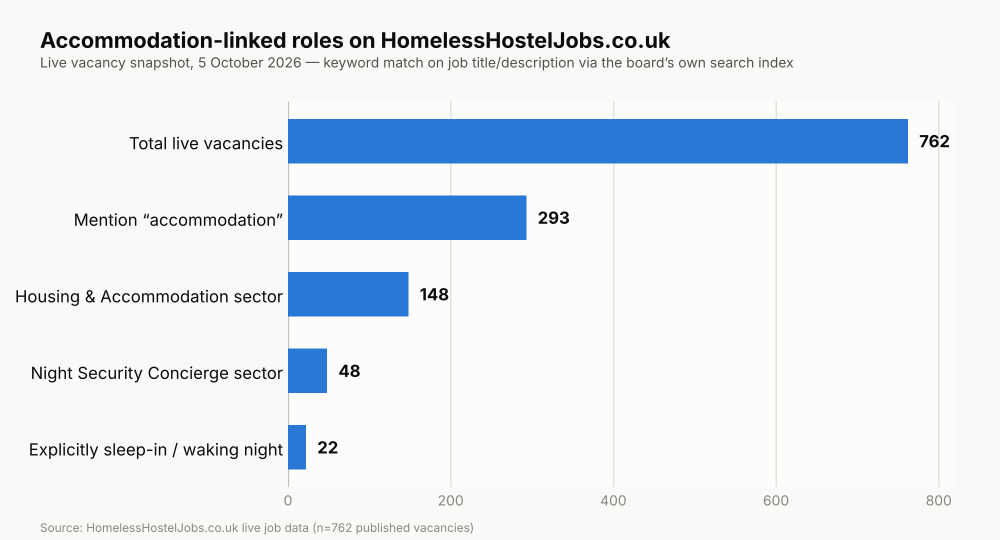
To put real numbers behind this rather than general impressions, we pulled a snapshot of every live vacancy on HomelessHostelJobs.co.uk on 5 October 2026 and checked how many reference accommodation-linked work:
Of 762 live, published vacancies, 293 (38%) mention "accommodation" somewhere in the job title or description — though, per the distinction above, most of these are Housing and Accommodation sector roles (148 of them) where accommodation is the subject of the work rather than a live-in benefit. A smaller, more specific group — 22 live vacancies — explicitly describe sleep-in or waking night patterns in their title or summary, and 48 sit in the dedicated Night Security Concierge category, where overnight and sleep-in patterns are most concentrated. These four figures are independent keyword cuts of the same live dataset rather than a strict funnel, and they'll shift as listings come and go — but they confirm the pattern is a real, ongoing part of the sector rather than a handful of edge cases.
What to check before applying
A few direct questions clear up most of the confusion in a sleep-in or live-in job advert:
Is it a sleep-in or a waking night? If the advert doesn't say explicitly, ask. A waking night role is paid in full for the whole shift; a sleep-in typically pays a flat allowance plus NMW for any time you're woken to work.
Is the accommodation free, or is there a charge? If there's a charge, how does it compare to the 2026–27 offset cap of £77.70 a week? A charge well above that, set against a modest salary, is worth querying before you accept.
Is it tied to the job? Live-in accommodation that's a condition of employment usually has to be given up if you leave the role, which matters for anyone relying on it as their main home. This is different from a housing-sector job that happens to involve housing policy or allocations work.
What's actually expected overnight? "Sleep-in, woken only in an emergency" and "sleep-in, expected to do a 2am medication round" are very different shifts even with the same job title — ask what a typical night actually involves.
Finding these roles on HomelessHostelJobs.co.uk
Live-in, sleep-in and waking night vacancies are listed across several categories on the board, most concentrated in Night Security Concierge and Housing and Accommodation. Each listing states the shift pattern and pay structure in the job description — if it doesn't say explicitly whether a role is a sleep-in or a waking night, or what accommodation (if any) is included, that's a reasonable first question to put to the employer before applying.