If you've searched for "drop in shelter support worker jobs," you've probably noticed something: most careers advice for the homelessness sector talks about hostels, not drop-ins. But day centres and drop-in services are a real, distinct part of the sector — and the support worker roles inside them are different in important ways from a residential job. Here's what the role actually involves, what it pays right now, and how to get into it.
What Is a Drop-In or Day Centre Support Worker?
A drop-in centre (also called a day centre) is a service people experiencing homelessness can walk into without an appointment — unlike a hostel, which provides overnight accommodation to a fixed group of residents. According to Croydon Council and The Salvation Army, typical drop-in services include hot meals, showers, clothing and toiletries, computer access for Universal Credit claims and job searching, and on-site "surgeries" from specialist teams such as substance misuse workers, mental health outreach staff and housing advisers. Some sessions also connect visitors to legal advice or refugee support organisations.
A support worker in this setting spends their shift with a constantly changing group of visitors rather than a fixed caseload of residents. The job blends practical support (serving food, signposting to services, helping with paperwork) with the same core relationship-building and safeguarding work found in residential roles — but compressed into much shorter, one-off contacts, since most people who attend a drop-in are not there overnight.
What the Role Actually Involves
Job descriptions for outreach and day centre roles on the board consistently include a mix of the following:
- Welcoming and registering new visitors, and carrying out basic risk/needs assessments on the spot
- Providing practical support — food, clothing, hygiene facilities, phone/internet access
- Signposting or referring people into housing, health, benefits and substance misuse services
- Supporting visitors with forms, appointments and Universal Credit claims
- Building trust with people who may not engage with more formal services, often the first step toward an accommodation pathway
- Recording contacts and safeguarding concerns accurately, in line with the organisation's policies
Many of these roles sit alongside — or are combined with — street outreach work, where staff go out to find and engage people sleeping rough rather than waiting for them to come in.
Real Roles, Right Now: What's Live on the Board Today
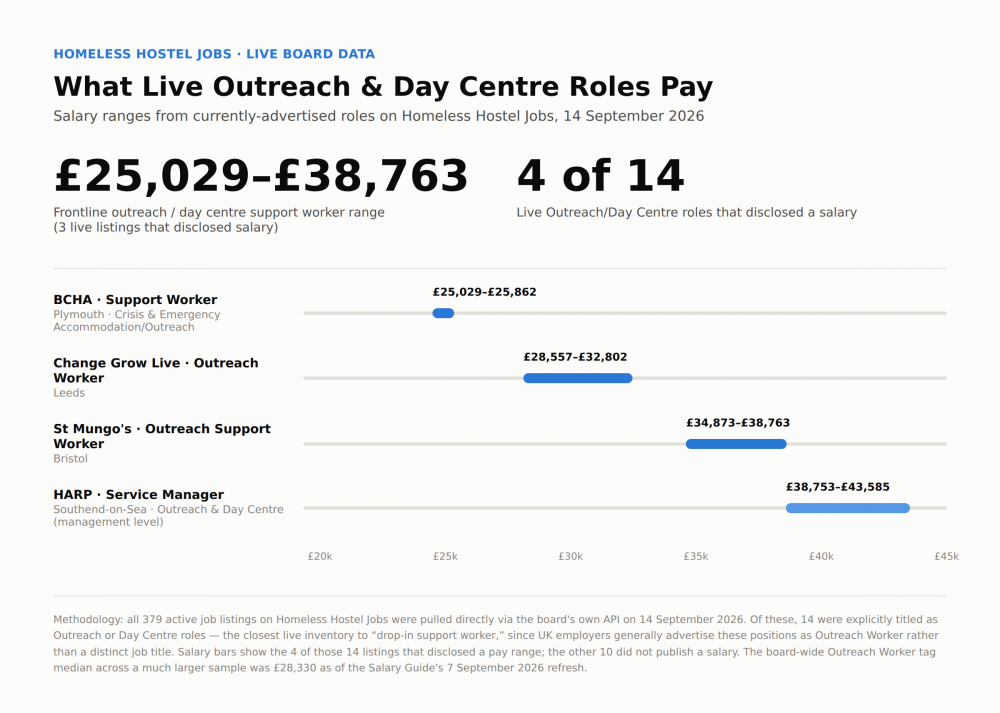
Rather than describe the role in the abstract, here's what's actually posted on Homeless Hostel Jobs as of 14 September 2026. Of 379 live job listings board-wide, 14 are explicitly titled as Outreach or Day Centre roles — this is the closest live inventory to "drop-in support worker," since UK employers in this sector generally advertise these positions under "Outreach Worker," "Outreach Support Worker" or occasionally "Day Centre" titles rather than "drop-in worker" specifically.
Of those 14 live roles, 4 disclosed a salary at the time of writing:
- BCHA, Plymouth — Support Worker, Crisis & Emergency Accommodation/Outreach: £25,029–£25,862
- Change Grow Live, Leeds — Outreach Worker: £28,557–£32,802
- St Mungo's, Bristol — Outreach Support Worker: £34,873–£38,763
- HARP, Southend-on-Sea — Service Manager, Homelessness Outreach & Day Centre: £38,753–£43,585 (senior/management level)
The other 10 live roles did not publish a salary — in line with the roughly one-in-two disclosure rate seen across the board generally. This is a small, real-time snapshot rather than a full market survey, so treat the exact figures as indicative of the current spread rather than a definitive average.
How Much Do Drop-In and Outreach Support Roles Pay?
Putting the three frontline (non-management) live listings above together, current outreach/day-centre support worker roles on the board span roughly £25,000 to £39,000, with the wider variation driven by location and employer rather than the role itself. For a broader, larger-sample benchmark, our UK Homelessness & Housing Sector Salary Guide puts the board-wide median for the "Outreach Worker" tag at £28,330 (based on a much larger sample, refreshed 7 September 2026) — consistent with the live listings above once you exclude the single management-level posting.
What Qualifications and Checks Do You Need?
There's no dedicated "outreach worker" apprenticeship or qualification route in the UK — these roles are recruited as a specialism within the broader support/social care worker career, so the National Careers Service's residential support worker profile is the closest official benchmark. It lists a starting salary of around £22,000 rising to roughly £30,000 with experience — broadly in line with the frontline range found above — and confirms candidates must pass an enhanced DBS check.
Entry routes include:
- A college course in health and social care (entry requirements vary by level)
- An apprenticeship — foundation level apprenticeships need no specific qualifications, while advanced apprenticeships typically ask for 5 GCSEs at grades 9–4 (A*–C) including English and maths
- Direct application with a relevant qualification plus paid or voluntary experience in social care or the homelessness sector
Because drop-in and outreach work involves unpredictable, sometimes high-risk situations with people you've often just met, employers tend to weight lived or volunteered frontline experience — food bank shifts, soup runs, befriending schemes — highly alongside formal qualifications. If you're starting from zero experience, our guide on how to get a homeless hostel job with no experience covers the entry-level roles and training routes most employers accept.
How Is This Different From a Hostel-Based Support Worker Role?
The core skills overlap heavily, but the working pattern is genuinely different:
- Caseload: a hostel worker supports a fixed group of residents over weeks or months; a drop-in worker sees a much larger, constantly changing group, often for a single short contact.
- Setting: drop-ins typically run set daytime sessions rather than round-the-clock shifts, so hours are often more predictable than hostel night/weekend rotas — though outreach components can add evening or early-morning work.
- Relationship-building: with less time per person, drop-in staff rely more on rapid trust-building and signposting, while hostel staff do more sustained, longer-term support planning.
- Entry point into services: drop-ins are frequently the first point of contact for someone not yet ready to accept a bed — meaning the job carries real weight in getting people into accommodation in the first place.
How to Find and Apply for These Roles
New outreach and day centre vacancies are added to Homeless Hostel Jobs throughout the year as charities and local authorities recruit. Search "outreach" or browse our Support & Frontline Services category to see what's currently live, and set up a job alert so you hear about new postings as soon as they go up.
Looking to move into frontline homelessness work? Browse current Support & Frontline Services roles on Homeless Hostel Jobs, or read our guide to getting started with no experience.
Key Takeaways
- Drop-in and day centre support work is a distinct specialism from residential hostel work — shorter, higher-volume contacts rather than a fixed caseload.
- 14 live roles on the board are explicitly titled Outreach or Day Centre as of 14 September 2026; disclosed salaries for frontline roles ranged £25,029–£38,763.
- The board-wide Outreach Worker median (larger sample) is £28,330, consistent with the live listings once management-level roles are excluded.
- There's no dedicated "outreach worker" qualification — enhanced DBS checks and the general support-worker entry routes (college, apprenticeship, direct application with experience) apply.
- Frontline volunteering (food banks, soup runs, befriending) is a genuinely useful stepping stone into paid outreach and drop-in roles.
Frequently Asked Questions
Is a drop-in support worker the same as an outreach worker?
They overlap significantly and are often the same job — many roles combine centre-based drop-in shifts with street outreach. Employers use "Outreach Worker," "Outreach Support Worker" and occasionally "Day Centre Worker" fairly interchangeably.
Do I need experience to apply?
Most advertised roles ask for some paid or voluntary experience in social care or homelessness services, though requirements vary by employer. See our no-experience guide for roles that accept beginners with full training.
What DBS check level is required?
An enhanced DBS check, in line with the National Careers Service's guidance for residential and frontline support worker roles.
Are these roles full-time or part-time?
Both — the live listings above include full-time permanent posts and part-time roles, and hours vary depending on whether the position combines centre-based and street outreach work.
How much can I expect to earn?
Based on current live listings and the board's wider salary data, expect roughly £25,000–£39,000 for frontline roles, rising further at senior/management level.